


The cost of living in the Cayman Islands is a common concern for anyone considering a move, but the reality is often more positive than many headlines and forum discussions suggest. While housing and imported goods can be more expensive than in larger economies, overall living costs depend heavily on lifestyle, location and household size. For many professionals, strong salaries and the absence of income tax mean that living in the Cayman Islands can still be financially rewarding, with real scope to save while enjoying an excellent quality of life.
--------------------------------------
The cost of living in the Cayman Islands is a topic that comes up time and again for lawyers considering a move. Headlines often claim that the Cayman Islands are the second most expensive place in the world to live, and it is not uncommon to see comments online inflating the amount they spend. It’s therefore understandable that cost of living is an important topic for lawyers (and their partners) exploring a move offshore.
But how realistic are these claims?
Between the team at The Agency Legal Talent, we have a combined nearly 30 years’ experience living in the Cayman Islands, across a variety of living arrangements and lifestyles. Over that time, we’ve learned a great deal about the realities of day-to-day life here, the ways new arrivals can manage their expenses effectively, and why Cayman on-the-ground recruiter expertise matters.
In this guide, we break down the actual cost of living in the Cayman Islands, from housing and groceries to utilities, transportation and schooling, to help lawyers gain a realistic understanding.
The Cayman Islands offers an outstanding quality of life, and while the cost of living is higher than some onshore markets, there are clear reasons for that. As a small island economy with limited supply, Cayman depends heavily on imported goods, which naturally affects the price of everyday items. Housing is also in high demand, particularly among expatriate professionals, which can put pressure on the rental market, while higher local wage levels often flow through to service costs. That said, for many offshore lawyers, these factors are offset by strong salaries, zero income tax, and access to a safe, well-developed jurisdiction with excellent lifestyle benefits, as reflected in real-life answers from lawyers who have made the move offshore.
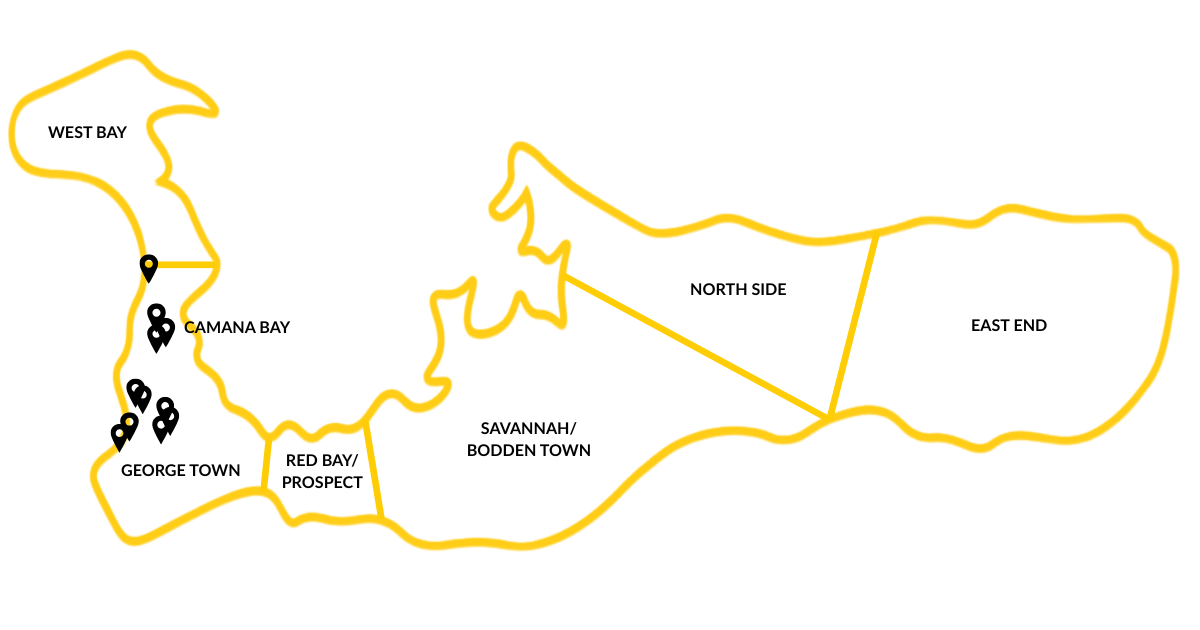
For lawyers relocating to the Cayman Islands, housing costs tend to vary primarily according to three factors: first, the location of the property and its proximity to George Town, Seven Mile Beach, and Camana Bay; second, the type and size of the home, whether that is an apartment, a property within a residential complex, or a detached house; and third, whether the property is furnished or unfurnished.
The table below summarises typical monthly rent ranges for long-term accommodation by area.

Note: These commute times are for peak tourist season (December-April). After this time, commute times dramatically decrease as cruise ships are not as frequently docked in George Town. Commute times reduce further during June-August when schools close for the summer holidays and many parents leave island to visit home or vacation.
For context, most offshore law firms in the Cayman Islands are based in George Town or Camana Bay. The list below shows where many of the island’s main law firms are located:
Walkers: 190 Elgin Ave, George Town, Cayman Islands
Mourant: 94 Solaris Avenue Camana Bay, Cayman Islands
Maples: Ugland House South Church Street, George Town, Cayman Islands
Ogier: 89 Nexus Wy, Camana Bay, Cayman Islands
Collas Crill: Willow House Cricket Square, George Town, Cayman Islands
Conyers: 171 Elgin Ave, George Town, Cayman Islands
Campbells: Willow House, George Town, Cayman Islands
Appleby: 60 Nexus Wy, Camana Bay, Cayman Islands
Harneys: 103 S Church St, George Town, Cayman Islands
Priestleys: Caribbean Plaza, 878 W Bay Rd, Cayman Islands
McGrath Tonner: Genesis Building, George Town, Cayman Islands
Loeb Smith Attorneys: Zephyr House, George Town, Cayman Islands
Grocery prices are another important component of the overall cost of living in the Cayman Islands.

The table below provides an example shop using common everyday items purchased at Foster’s Supermarket, one of the island’s major grocery chains.

Note: These prices are from Foster’s on 4th March 2026. There are cheaper or more expensive versions of all items listed, but this is what a typical person might purchase weekly as essentials.
To put this into perspective, the table below illustrates how a typical weekly shop could translate into daily meals, along with the estimated cost.
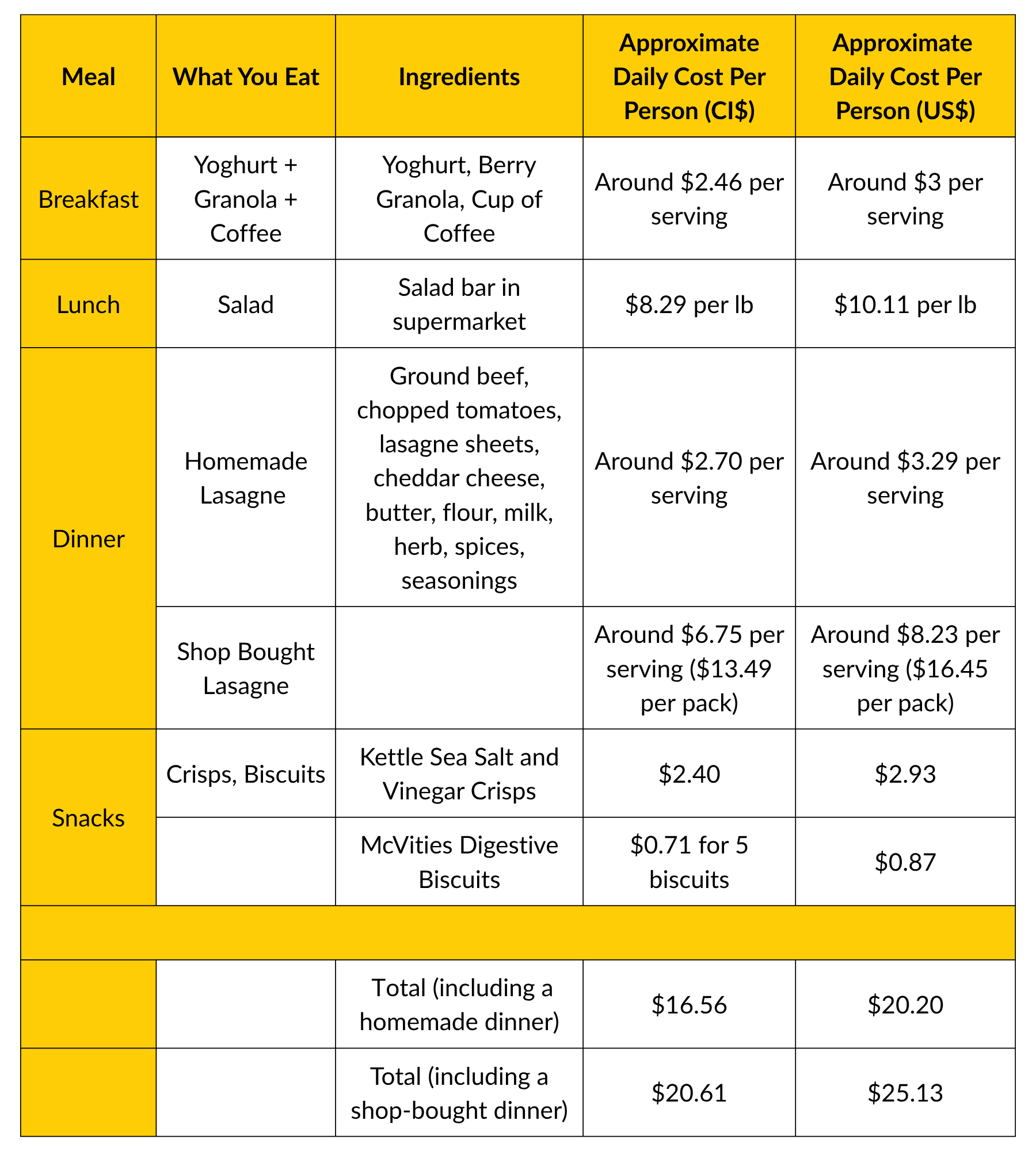
The Cayman Islands are widely considered the ‘Culinary Capital of the Caribbean’ and you will be spoilt for choice with over 300 restaurants which range from food shacks to 5-star restaurants.
Dining costs vary widely depending on the restaurant and style of meal. Casual lunches can cost around CI$10–CI$15, while mid-range dinners typically range from CI$20–CI$40 per person. Higher-end restaurants can exceed this, particularly for premium seafood or steak.
Below are some examples of average costs:
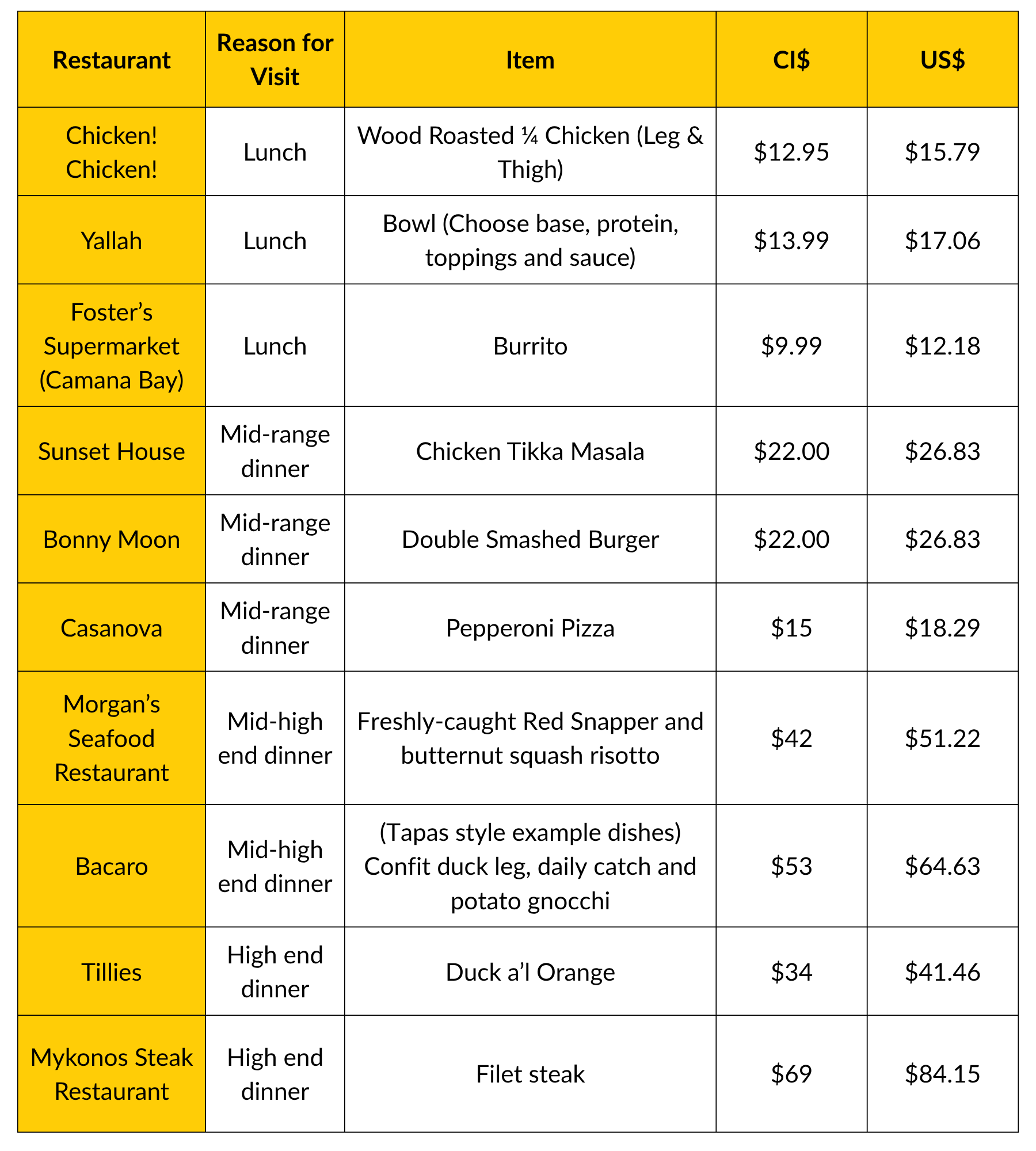
Note: menu prices are not always ‘all-in’ (service charge/gratuity varies by establishment but is usually 15-18% and is usually visible at the bottom of the menu).
Gym memberships are another lifestyle cost worth factoring into the overall cost of living in the Cayman Islands, although prices vary depending on the level of access and facilities included.
Below are some examples of gym membership prices:
Many apartments that are based on complexes also have on-site gyms.
Entertainment and leisure are also worth factoring into the overall cost of living in the Cayman Islands, particularly as many new arrivals find themselves making the most of the island’s active social scene and outdoor lifestyle.
There is usually plenty happening across Grand Cayman, and apps such as What’sOnCayman can be useful for finding local events and activities. Typical costs are relatively accessible, with bowling around CI$15.50 to CI$18.50, standard cinema tickets at approximately CI$13, and outdoor pickleball court rental at around CI$32 per hour (typically split between four people).

Electricity is an important day-to-day living cost to factor into any relocation budget in Grand Cayman, particularly because air conditioning typically accounts for a significant share of household usage. Caribbean Utilities Company Ltd (CUC) is the island’s sole electricity provider, and as of July 2025, the base residential rate was CI$0.1356 per kWh, with a monthly facility charge of CI$6.82. For relocating lawyers, utility costs can therefore vary depending on the size of the property and how heavily air conditioning is used.
All current electricity billing rates are available on CUC’s website.
Water is another everyday utility cost to factor into living expenses in Grand Cayman, with charges depending on where you live and how much water your household uses. The island is served by two providers: Water Authority Cayman, which covers most of Grand Cayman and Cayman Brac, and Cayman Water, which supplies the Seven Mile Beach and West Bay areas.
For residential customers with Water Authority Cayman, the first 12 cubic metres (approximately 3,200 US gallons) are charged at around CI$4.34 per m³, with usage above that costing CI$5.57 per m³, plus a small statutory fee and monthly meter charge. Cayman Water customers are typically charged CI$18.98 per 1,000 gallons for the first 3,000 gallons, rising to CI$22.77 per 1,000 gallons for additional usage, alongside meter and energy adjustment charges. In practice, monthly water bills for many households are relatively modest compared with other living costs, but they can vary depending on property size and consumption.
Home internet is another monthly expense to factor into the overall cost of living in the Cayman Islands, particularly for lawyers who value reliable high-speed service for remote access or international calls. Four providers currently offer residential internet plans — Logic, FLOW, Digicel and C3 — with Logic covering most homes across the island. Packages start from around CI$89 per month for 300Mbps, which provides a useful baseline when budgeting for household utilities and connectivity.
Mobile phone costs are generally a manageable part of day-to-day living expenses in the Cayman Islands, with two providers - Digicel and FLOW - offering both prepaid and postpaid plans. For example, Digicel’s data-only options include a 30-day 5GB plan at around CI$35, while plans with international calling can cost around CI$50 per month.
A typical monthly breakdown might look something like the below:

Actual costs can vary depending on property size, air conditioning usage and internet speed packages.
For lawyers relocating to Grand Cayman, public buses offer a relatively low-cost way to get around the island and can help reduce the overall expense of car ownership.
Fares are modest, with most journeys costing CI$2, rising to CI$3.50 for trips beyond Frank Sound junction and CI$8 for longer routes to areas such as Rum Point or Cayman Kai.
Buses run across nine routes, seven days a week, with all services operating to and from the central bus depot in George Town. While many professionals choose to drive, the bus network can be a useful budget-friendly option, particularly for those living and working in or near George Town.
Taxis are widely available in Grand Cayman, but they are generally one of the more expensive transport options and can add up quickly if used regularly.
A trip from the top of Seven Mile Beach to South Sound at rush hour would cost around $30-35 as an example.
They are most commonly found at the airport and around the cruise terminals in George Town, making them convenient for occasional trips or for new arrivals before securing a car.
For those trying to manage day-to-day living costs, apps such as CI:GO, which helps estimate official taxi fares, and Island: GO!, which allows users to view pricing in advance and book local drivers, can make it easier to budget and compare transport costs.
Whether a car is necessary in Grand Cayman largely depends on where you live, where you work, and how you plan to spend your time outside the office.
For example, someone living in West Bay and commuting to Camana Bay or George Town may find that owning a car is the more practical option, despite the added expense.
For those considering buying rather than renting, second-hand vehicles are widely available through platforms such as eCayTrade and Facebook Marketplace, with prices typically ranging from CI$5,000 to CI$15,000. It is also common practice to have a local mechanic inspect a used car before purchase, which can help avoid unexpected costs later on.
There are also plenty of dealerships on island to purchase or lease a new car if you choose to. Prices will be higher than you might expect back home because of the import costs and limited car availability.
Car rental is a common short-term option for new arrivals in Grand Cayman, particularly during the first few months of relocation, and typically costs around CI$500 per month.
While that is more expensive than using the public bus network, it can be a practical alternative to buying a car immediately and gives lawyers time to settle in before making a longer-term decision.
Many rental providers offer resident rates, which can make the cost more manageable.
Fuel is another everyday cost to factor for those who choose to own a car.
As of 9th March 2026, the average self-serve price across the island was CI$5.06 per imperial gallon for regular gasoline and CI$5.12 per imperial gallon for diesel, although prices do vary between stations.
For those building a realistic monthly budget, fuel costs are therefore worth considering alongside car ownership, insurance and maintenance. Up-to-date retail fuel prices are published regularly by OfReg.
Holding a full and valid domestic driver’s licence from a Convention country means you are permitted to drive in Cayman for up to six months before needing to sit the written theory test and obtain a Cayman driver’s licence.
The cost of the test, licence and related fees is around CI$125.
Health insurance is a mandatory part of living and working in the Cayman Islands, and every resident must be covered by at least the Standard Health Insurance Contract (SHIC), which provides basic medical coverage.
In practice, most employees receive health insurance through their employer, who are legally required to pay at least 50% of the premium. Basic SHIC plans cost around CI$167 per month per employee, while more comprehensive policies with broader outpatient, dental or international coverage can range from CI$650 to over CI$2,000 per month, depending on the level of benefits and the individual insured.
For those lawyers that are relocating to the Cayman Islands with children, school fees are often one of the most significant costs to factor into the overall cost of living.
Places in government schools are limited and prioritised for Caymanian children, meaning many expat families choose private education. Annual fees vary widely by school and year group, with examples including St Ignatius at CI$12,975 to CI$18,740, Footsteps at CI$15,600, Cayman International School at CI$18,000 to CI$29,710, CF School at CI$19,740, and Cayman Prep at CI$15,885 to CI$20,160. For families moving offshore, this can make education one of the key budget considerations alongside housing.
The example below illustrates a typical monthly budget for a professional living in the Cayman Islands without children.
Even after accounting for rent, utilities, groceries and lifestyle spending, many offshore professionals find they are able to retain a substantial portion of their income due to high salaries and zero income tax.
.png)
*Law firms will usually help with temporary accommodation (average is around 2-4 weeks), car hire for a month, flights and/or a lump sum. This will help you cover these expenses so that you are not left out of pocket.
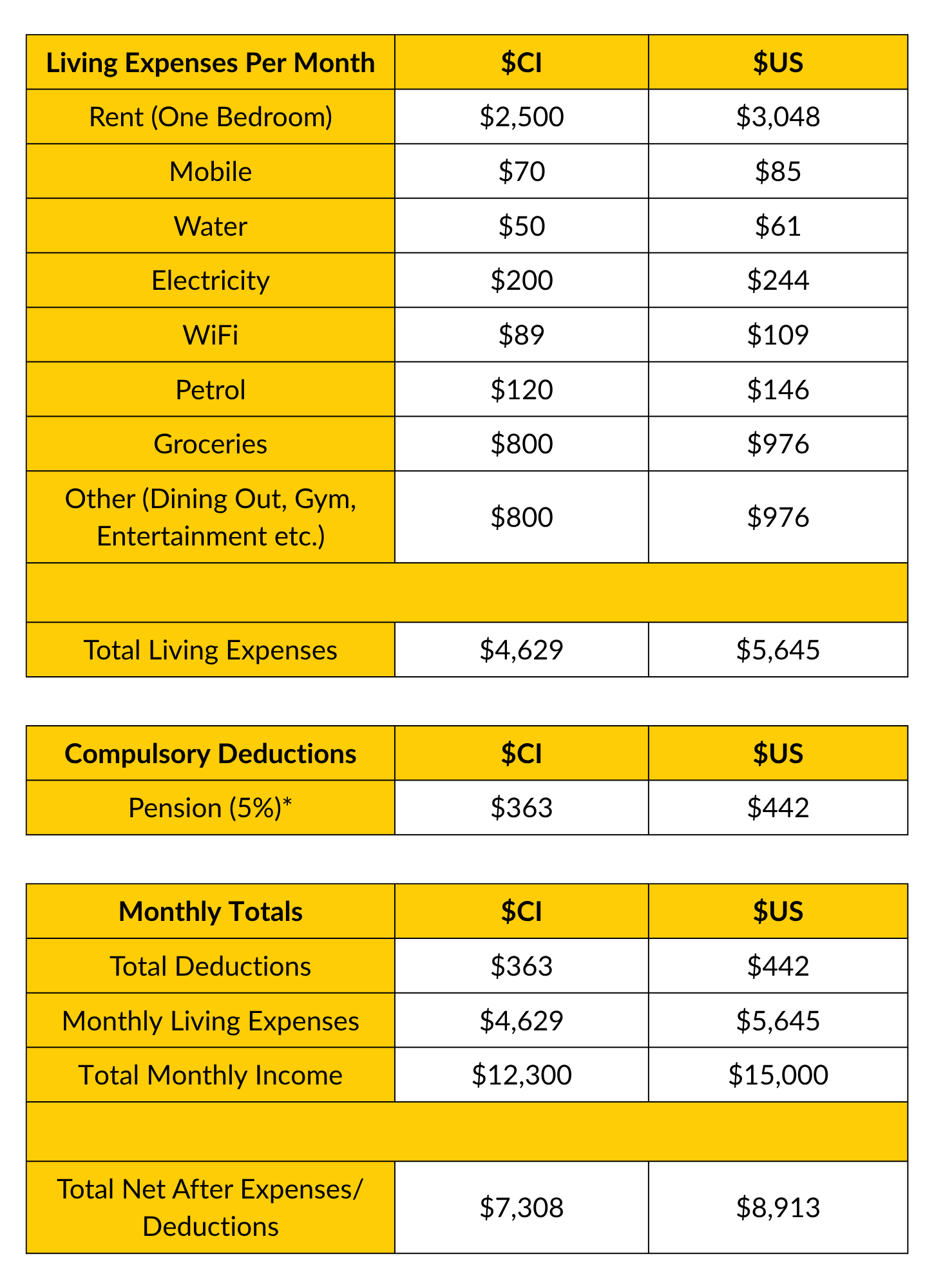
Note: All figures are accurate to the best of our knowledge as of 4th March 2026. Costs can vary depending on lifestyle, market conditions, and individual circumstances, but these figures reflect the typical costs for a single professional living in the Cayman Islands.
*Pension is only deducted from your pay cheque after you have been working on island for 9 months.
Living in the Cayman Islands can cost as much or as little as you choose depending on lifestyle, housing choices, and spending habits. While certain everyday expenses may be higher than in larger economies, the combination of strong offshore salaries, zero income tax, and an exceptional quality of life means many lawyers find the financial and lifestyle benefits more than offset the higher prices.
For professionals considering a move offshore, understanding the real cost of living is an important first step in planning a successful relocation, alongside gaining a clearer understanding of the Cayman legal market, the types of roles available, and what to expect from offshore legal practice.
--------------------------------------
Whether you’re exploring roles with leading offshore law firms or seeking tailored relocation advice, our team is here to help.
Still deciding between offshore jurisdictions? Compare the Cayman Islands, Channel Islands, BVI and Bermuda to see which is the best fit for you.
--------------------------------------
Notes: As of 4 March 2026, US$1 = US$0.82, this exchange rate has been used throughout this article.
Disclaimer: The Agency Legal Talent has made every effort to ensure the information and estimated costs in this guide are accurate at the time of publication. However, living expenses in the Cayman Islands can vary depending on lifestyle, market conditions, and individual circumstances, and the figures should be treated as general guidance only.